When I first started exploring AI, I pictured mysterious servers glowing somewhere in the desert, humming equations I’d never understand. Turns out, AI learning isn’t that different from how we learn , just with fewer snack breaks and more GPUs. Here’s my running commentary on the ways machines (and sometimes humans) learn.
Supervised Learning — The Teacher’s Pet
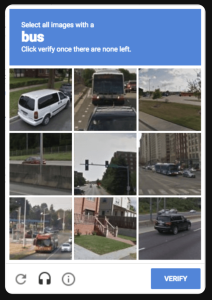
In supervised learning, the model gets examples with the answers attached.
It’s like flashcards for robots:
“This is a cat. This is also a cat. That’s a dog. No, still a cat.”
Over time it learns the pattern. And me? I’ve been part of this system all along squinting at CAPTCHAs, labeling traffic lights, crosswalks, and the poor soul with the polka-dot umbrella.
I thought I was proving I wasn’t a robot. Turns out, I was training one.
That’s supervised learning: humans labeling the world so machines can catch up.
Unsupervised Learning

When I once typed “Diane Lane” into Netflix purely for cinematic reasons, of course my feed suddenly filled with movies about infidelity. That’s unsupervised learning in action. It simply looked at the watch patterns of millions of people who also searched “Diane Lane” and discovered a hidden cluster: these users often end up watching “Unfaithful,” “Eyes Wide Shut,” and other midlife-crisis cinema. It didn’t know the meaning of fidelity or Diane Lane, it just noticed patterns.
That’s what unsupervised learning does:
it finds associations in the data, whether or not we meant to reveal them.
The model doesn’t judge. It just groups.
We’re the ones who have to live with the awkward recommendations.
Semi-Supervised Learning
There’s an old Tamil saying: “A pot of rice can be judged by a single grain.”
That’s semi-supervised learning in a sentence.
In medicine, it’s not always possible to label millions of scans , each one needs a radiologist’s eye and hours of expertise.So instead, a model learns from a small set of labeled cancer images, then applies what it’s learned to a much larger pool of unlabeled ones.
It starts spotting subtle textures, light gradients, tissue density that even trained eyes can miss.
That’s why semi-supervised learning is quietly powering breakthroughs in cancer detection, diabetic retinopathy, and lung nodule screening.
Self-Supervised Learning
Here, the AI hides part of the input and tries to predict it. That’s how language models like ChatGPT train: by filling in blanks billions of times. Think of autocorrect. It read oceans of text, learning that “I’m on my” is usually followed by “way,” not “llama.” That was Self-Supervised Learning
Reinforcement Learning
Reinforcement learning is all about feedback. The model acts, gets rewarded or punished, and updates its playbook.That’s how AlphaGo mastered Go .
Transfer Learning
Self-driving car models are often trained in simulation environments first (cheap, safe, controlled), then fine-tuned on real-world traffic data.
The pattern recognition of lanes, pedestrians, intersections transfers from virtual to reality.
Federated Learning
Most people think Siri just listens, answers, and sometimes gets things hilariously wrong.
What they don’t see is that Siri like millions of her clones on iPhones worldwide, is quietly learning every day.
Each iPhone keeps track of your accent, your tone, your phrasing.
It trains a tiny model locally on your device to better understand your speech patterns, without sending the raw audio to Apple.
Once in a while, your phone sends back small mathematical changes to the model and not your recordings or transcripts.
Apple’s servers then aggregate those updates from millions of users, average them out, and push back a smarter, global Siri model to every device.
No one outside ever hears your voice.
But Siri still gets better because everyone contributes, privately.
| Type of Learning | How It Learns | Everyday Example | Real-World Application |
| Supervised Learning | Learns from labeled data | Clicking all the traffic lights in a captcha | Image recognition, |
| Unsupervised Learning | Finds hidden patterns | Netflix showing you infidelity dramas after one “Diane Lane” search | Recommendation engines |
| Semi-Supervised Learning | A few labels teach the rest | “Taste one grain, judge the pot of rice.” | Cancer detection, |
| Self-Supervised Learning | Predicts what’s missing | Autocorrect turning “I dare you” → “I date you” | GPT-style language models |
| Reinforcement Learning | Trial, error, reward | Learning not to shop online at 2 AM | Autonomous driving |
| Transfer Learning | Applies past experience | Thinking you can fly a plane because you ride an e-bike | Multilingual translation |
| Federated Learning | Learns together, keeps data private | Gboard learning your slang without sending your messages | Keyboard prediction |
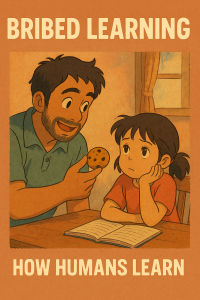
| Bribed Learning | Motivation through rewards | “Finish math homework, get a cookie.” | Education gamification, sales incentives (and parenting!) |